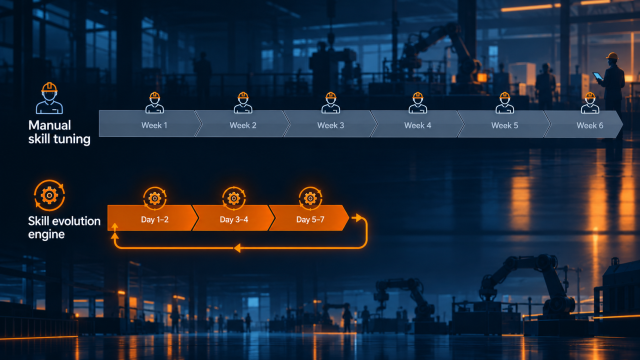
A pivotal shift is underway: Europe’s legacy in precision manufacturing is no longer just about the past—it’s the foundational data set for its AI-powered industrial future, offering a tangible $15 billion market opportunity by 2033.
In January 2026, at the World Economic Forum in Davos, a clear directive was issued to European industry. NVIDIA’s founder and CEO, Jensen Huang, framed artificial intelligence and robotics not merely as another technological trend but as a “once-in-a-generation” Europe AI robotics opportunity for the continent.
This statement moves beyond promotional rhetoric; it is a strategic analysis rooted in Europe’s unique industrial identity. While the U.S. has dominated the software era, Europe’s path to AI leadership runs through its factory floors, machine halls, and precision engineering heritage. This article analyzes the core reasons why this moment is decisive for Europe, examining the convergence of physical industrial strength with artificial intelligence, and what must be addressed to transform potential into lasting advantage.
- The Foundational Advantage: Europe’s dense ecosystem of industrial “hidden champions” and its deep engineering heritage provide a real-world training ground for physical AI that pure software economies cannot easily replicate.
- The Critical Juncture: The transition from generative AI to physical AI represents a platform shift. Success requires moving beyond data silos to collaborative data-sharing frameworks and serious investment in energy and compute infrastructure.
- The Tangible Outcome: This is not speculative. Market forecasts project the European smart robotics sector to grow to nearly $16 billion by 2033, driven by the need to address acute labor shortages and enhance productivity across logistics, manufacturing, and healthcare.
Why Europe’s Industrial Heritage is the Ultimate AI Launchpad
Europe’s competitive edge in the age of AI robotics is not found in chasing the latest software application but in leveraging its century-old industrial soul. Huang specifically highlighted Europe’s “incredibly strong” industrial manufacturing base as the core asset. This strength is quantified in a global landscape where the installed base of industrial robots reached a record value of $16.7 billion, with Europe being a primary contributor.
The continent’s economy is underpinned by a vast network of medium-sized Mittelstand firms—the “hidden champions” that lead global niche markets in automotive components, specialized machinery, and industrial equipment. These companies represent a living, breathing dataset of complex physical processes, quality standards, and supply chain intricacies. They are the ideal launchpad for physical AI, where high labor costs and precision requirements make the return on robotics investment both faster and more predictable.
Why the Shift to ‘Physical AI’ Changes Everything
The narrative around AI is evolving from digital content creation to tangible interaction with the physical world. Huang described this as fusing “your industrial capability with artificial intelligence,” which brings you into the domain of physical AI, or robotics. This shift is monumental. It moves AI from the cloud directly onto the assembly line, into the warehouse, and alongside human workers. A leading automotive manufacturer, for instance, used AI to transform its manual procurement processes, achieving over 20% efficiency gains.
The key technologies enabling this are evolving rapidly: Generative AI allows robots to learn new tasks through simulation, while Agentic AI combines analytical and generative capabilities for true autonomy in complex environments. This evolution means the value is no longer just in the algorithm, but in its seamless integration with motors, sensors, and real-world physics—a domain where European engineering excels.
Consider this fictional scenario: An engineer at a German automotive supplier faces a recurring, minute defect in a welded component. Traditional vision systems struggle with the variance. Using an AI-powered robotic system, she doesn’t just reprogram a rule; she teaches it. She shows it hundreds of video examples of “good” and “bad” welds from their proprietary production history. The system learns the subtle visual and sensor-data patterns humans intuitively understand but could never code explicitly. The defect is caught in real-time, saving millions in potential recalls. This is physical AI in action.
Why Energy and Infrastructure Are Non-Negotiable Foundations
Huang paired his optimistic vision with a stark warning: Europe must “get serious about increasing your energy supply” to build the necessary AI infrastructure. He framed the global AI build-out as “the largest infrastructure buildout in human history,” already involving hundreds of billions of dollars with trillions more required.
This is a tangible constraint. AI data centers and advanced robotics operations are immensely power-hungry, and Europe faces some of the world’s highest energy costs. Microsoft CEO Satya Nadella echoed this at Davos, noting that energy costs are a decisive factor in a nation’s AI competitiveness. The challenge is two-fold: securing abundant, affordable, and sustainable energy for new infrastructure, and modernizing the power grid to support it. Without a strategic plan to address this, Europe’s industrial base could be hamstrung by its own operational costs.
Why Collaboration, Not Just Innovation, Will Determine the Winner
The final, and perhaps most culturally significant, hurdle is collaboration. The World Economic Forum analysis argues compellingly that “the silver bullet isn’t new tech; it’s collaboration”. Physical AI thrives on vast, heterogeneous real-world data to train robust models. No single European company, regardless of size, possesses enough diverse operational data to build a world-class model alone.
The solution lies in creating shared data spaces and digital twins where companies can pool non-confidential operational data. Imagine the acceleration in autonomous logistics if rival automotive firms shared anonymized supply chain data, or if pharmaceutical companies collaborated on biomaterial handling robotics. This requires a monumental shift from a mindset of data hoarding to one of data sharing for mutual advancement. Furthermore, regulatory harmonization across the EU is crucial to create a single market for robotics, where a robot certified in one nation can operate seamlessly across the bloc.
FAQs: Europe AI Robotics Opportunity
What specific industries in Europe are leading in AI robotics adoption?
The automotive industry is a primary pioneer, with companies like Mercedes-Benz and Volvo actively announcing projects. Beyond automotive, strong momentum is building in industrial machinery, logistics and warehousing (driven by e-commerce), and the pharmaceutical sector. These are asset-intensive industries where precision and operational excellence are paramount.
How will AI robotics affect jobs in European manufacturing?
The prevailing expert view is that AI robotics will transform jobs more than eliminate them. Jensen Huang illustrated this with radiology, where AI tools have led to more radiologists, as they can focus on patient care rather than manual scan analysis. In factories, robots are seen as allies to address critical labor shortages, taking over dangerous, repetitive, or physically strenuous tasks, thereby allowing the human workforce to upskill into more supervisory, programming, and maintenance roles.
Is there significant investment and startup activity in European AI robotics?
Yes. Globally, robotics companies raised a record $26.5 billion in 2025. While a significant portion flows to U.S. and Asian firms, Europe’s ecosystem is buzzing. Venture capital is actively seeking “AI-native” companies in the physical world, and European founders are leveraging access to advanced AI models and cheaper hardware to build domestic champions. The total European smart robot market is projected to grow at a 15% CAGR, reaching $15.86 billion by 2033.
What is the biggest barrier holding Europe back from leading in this field?
The most frequently cited barrier is energy infrastructure and cost. Following closely is the need for a more collaborative, continent-wide approach to data sharing, standardization, and regulatory alignment to create scale. Overcoming a siloed mentality is as crucial as overcoming the physical infrastructure deficit.
Fast Facts
Jensen Huang’s “once-in-a-generation” claim identifies a decisive Europe AI robotics opportunity rooted in the continent’s unmatched industrial manufacturing base, which provides the perfect real-world training ground for physical AI. Realizing this $15+ billion potential requires Europe to tackle high energy costs, build collaborative data ecosystems, and leverage its engineering heritage to lead the shift to intelligent physical systems.
Further Reading & Related Insights
- UMEX & SimTEX 2026: The Tipping Point for Simulation and Training Technologies
Extends the discussion on physical AI by showing how simulation and training environments are becoming the foundation for robotics deployment at industrial scale. - Hyundai Atlas Humanoid Robot Factory Deployment
Provides a concrete example of humanoid robotics moving from labs into real factory environments—exactly the transition Europe must accelerate. - Why Domain Randomization in Industrial Robotics Is the Secret Weapon Behind Smarter, More Resilient Automation
Deepens the technical argument around physical AI training, reinforcing why Europe’s real-world industrial data is such a strategic advantage. - Industrial AI Strategy Analysis: How Robots, Tariffs, and Human Skills Define 2026’s Competition
Broadens the competitive lens, linking robotics adoption to geopolitics, labor dynamics, and long-term industrial positioning. - Robotics Simulation Is Now Replacing Physical Prototyping
Directly reinforces the article’s thesis that virtual-first development is becoming the dominant pathway to innovation in robotics and manufacturing.
The convergence of physical industry and artificial intelligence is the defining business transformation of our time. For a deeper, ongoing analysis of how these dynamics are reshaping global manufacturing and supply chains, subscribe to the CreedTec Insights newsletter. We cut through the hype to deliver the strategic intelligence you need.