Fast Facts
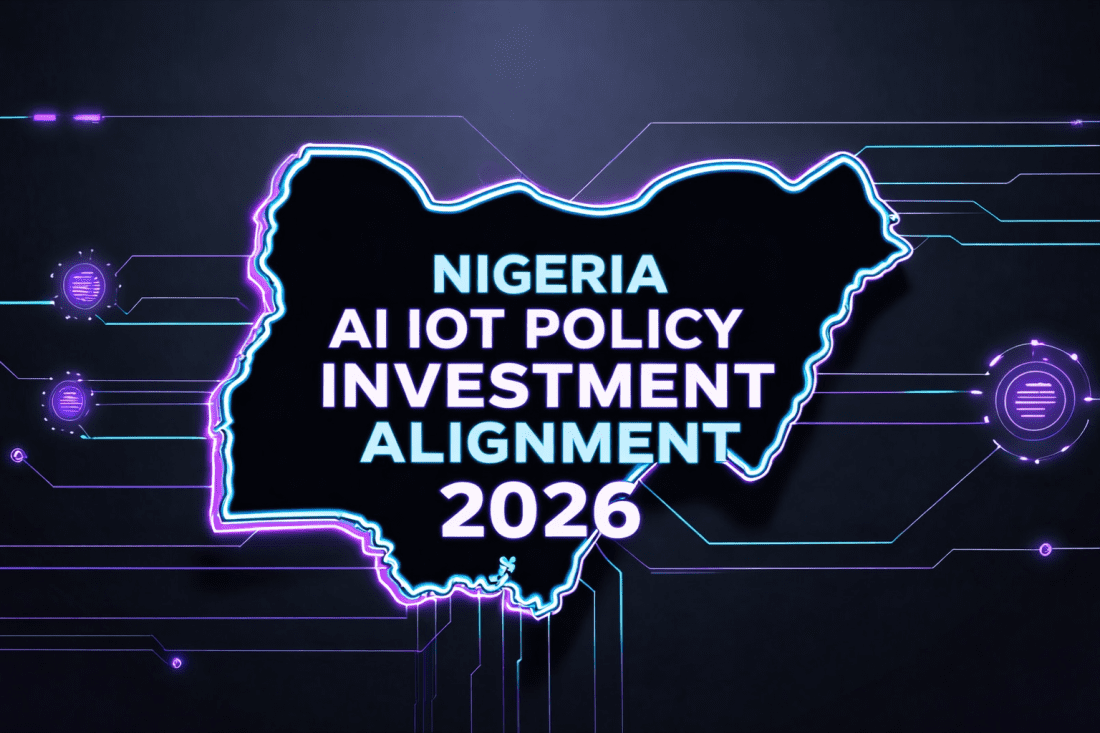
Nigeria stands at a pivotal moment in 2026. The success of its technological ambition hinges on one critical factor: Nigeria AI IoT policy investment alignment 2026. While a robust National AI Strategy exists and IoT connectivity is expanding, a persistent gap between policy frameworks and tangible investment threatens to derail the industrial transformation promised by AI and IoT. This analysis argues that synchronizing regulatory clarity, infrastructure funding, cybersecurity readiness, and workforce development is not optional—it is the single most important determinant of whether Nigeria will harness these technologies for inclusive growth or face deepened digital and economic divides.
The 2026 Crossroads for Nigeria’s Industrial Future
As 2026 unfolds, Nigeria’s technological ambition is clear. The National Artificial Intelligence Strategy (NAIS) outlines a vision to become a global AI leader, and recent licensing of satellite IoT providers promises to connect underserved millions. Yet, ambition alone is insufficient. The critical question for analysts and policymakers is not what technologies can do, but why a specific alignment of policy and investment is the non-negotiable catalyst for realizing their industrial potential.
This year, the convergence of AI and IoT is moving beyond basic automation into intelligent, autonomous systems capable of reshaping agriculture, logistics, manufacturing, and public services. However, as ICT expert Jide Awe warns, these gains also increase cybersecurity risks and can reinforce inequalities without “deliberate and inclusive policies”. The central argument of this analysis is that Nigeria’s long-term success depends on treating policy and investment not as separate tracks, but as two sides of the same coin. One cannot succeed without the other.
Achieving Nigeria AI IoT Policy Investment Alignment in 2026: The Core Imperative
A policy without funding is a mere statement of intent. Conversely, investment without a clear regulatory framework is a risky gamble. Nigeria’s 2026 landscape highlights this interdependence. The proposed National Digital Economy and E-Governance Bill, targeting passage by March 2026, seeks to establish enforceable AI standards and regulatory sandboxes to foster innovation. This policy clarity is designed to attract investment.
However, investment must meet the scale of the need. For instance, while mobile broadband penetration stood at roughly 50.58% in late 2025, the NAIS identifies foundational AI infrastructure—like high-performance computing—as a strategic pillar. Closing this gap requires coordinated public and private capital targeting specific, policy-directed outcomes. The alignment is crucial: investors need the confidence that comes from clear regulations, and policies require capital to manifest in tangible infrastructure.
A Fictional Anecdote: Imagine “Chike,” an agritech startup founder in Enugu. In 2025, he developed an AI-IoT solution for soil monitoring but stalled. Uncertainty around data governance made investors hesitant. The proposed 2026 law, with its clearer rules, could unlock the funding he needs. His story illustrates the human potential waiting at the intersection of policy and investment.
Why IoT Connectivity is the Backbone of Industrial AI
AI models are only as good as the data they process. Therefore, widespread, reliable IoT connectivity is the essential data-collection nervous system for industrial AI. Nigeria’s licensing of BeetleSat-1 and Satelio IoT Services in early 2026 is a direct investment aimed at strengthening this backbone, particularly for rural and hard-to-reach areas.
This expansion is not just about internet access; it’s about enabling the data flows that fuel smart applications. As Awe notes, there is “significant opportunity and growing demand for intelligent IoT applications in Nigeria’s power, agriculture, transportation, and security sectors”. For example, IoT sensors in the agricultural sector can provide real-time data on soil moisture and crop health, which AI models can then analyze to predict yields and optimize resource use—a concept known as precision agriculture. Without the IoT connectivity investment, these AI-driven sector transformations remain theoretical.
Why Cybersecurity Must Be a National Priority from the Start
The integration of AI and IoT exponentially increases the attack surface for critical infrastructure. Each connected device is a potential entry point. The expert consensus is unequivocal: “As billions of devices become essential to daily operations, strong security measures that assume no device is automatically trusted… will be essential”.
Policy must therefore mandate “security-by-design” principles within the IoT licensing and AI regulatory frameworks. Investment must concurrently flow into building national cybersecurity capabilities, AI-driven threat detection systems, and local expertise. The 2026 policy landscape, with its focus on risk-based regulation for high-risk AI applications, must be explicitly and generously funded to include cybersecurity enforcement mechanisms. Ignoring this need doesn’t just risk data breaches; it jeopardizes the entire trust foundation upon which digital transformation is built.
Why Workforce Development is the Ultimate Sustainability Test
Technology is built and managed by people. Arion Research (2025) indicates that 93% of Nigerian organizations have adopted AI, with 30% at an advanced stage. This rapid adoption creates a pressing demand for skilled professionals that currently outstrips supply. A strategy focused only on hardware and software will fail without a parallel, massive investment in human capital.
The NAIS correctly identifies the development of a robust AI workforce as a core objective. The tangible outcome needed in 2026 is a significant scaling of practical, industry-aligned training programs, university curricula, and upskilling initiatives. Investment here ensures that the benefits of AI and IoT are not confined to a tech-elite but create broad-based employment and empower local talent to solve local problems.
FAQs: Nigeria’s AI & IoT Alignment in 2026
1. What is the most important AI policy for Nigeria in 2026?
The anticipated National Digital Economy and E-Governance Bill is crucial as it aims to provide the first comprehensive, enforceable legal framework for AI development and deployment, reducing uncertainty for businesses and investors.
2. How is IoT connectivity improving in Nigeria in 2026?
The Nigerian Communications Commission (NCC) has licensed new satellite IoT providers like BeetleSat-1 and Satelio IoT Services. These seven-year licenses aim to expand broadband and IoT connectivity, especially to unserved rural communities.
3. What are the biggest risks of AI and IoT adoption in Nigeria?
Key risks include escalating cybersecurity threats to connected systems, the potential for AI to widen the digital divide, and a shortage of skilled professionals to implement and manage these technologies responsibly.
4. Which sectors will benefit first from AI-IoT integration?
Agriculture, financial services (fintech), power/energy, logistics, and public service delivery are prime sectors for immediate transformation due to existing demand and clear use cases for intelligent, data-driven systems.
The Call for Synchronized Action
2026 presents Nigeria with a defining choice. The components for a technological leap are there: a forward-looking AI strategy, evolving connectivity, and a vibrant startup ecosystem. The missing link is the deliberate, relentless synchronization of policy and investment. One must pull the other forward.
Policymakers must move swiftly to finalize and implement clear, innovation-friendly regulations. Simultaneously, the public and private sectors must direct capital towards the physical infrastructure, cybersecurity shields, and human talent that these policies envision. The goal is not just to adopt technology, but to build a resilient, inclusive, and sovereign digital economy.
As Jide Awe succinctly put it, “While the technologies are real, governance, investment, leadership commitment, and an innovative mindset among the population must also be equally strong”. In 2026, alignment is everything.
Further Reading & Related Insights
- Nigeria Satellite IoT Licenses: How NCC Is Reshaping Connectivity in 2026 → Deepens the regulatory and licensing context, explaining how NCC’s satellite IoT approvals form the backbone of Nigeria’s expanding IoT ecosystem.
- AT&T’s IoT Network Intelligence Platform → Illustrates how carrier-grade network intelligence platforms address visibility, reliability, and scale challenges relevant to Nigeria’s satellite IoT ambitions.
- IoT Operational Intelligence in Nigeria → Connects policy and connectivity to real operational outcomes, highlighting how IoT intelligence is already being applied within Nigerian industries.
- Why IoT in 2026: Regulatory Standards and Growth → Provides global regulatory perspective, reinforcing why Nigeria’s 2026 timing and standards-driven approach matter for investor confidence and long-term adoption.
- AI Cybersecurity Threats to IoT Devices → Reinforces the security dimension, underscoring why satellite and large-scale IoT deployments must embed cybersecurity from the policy and licensing stage.
Stay Ahead of the Curve on Industrial AI
Want deep-dive analysis on how policy and investment are shaping the future of AI in emerging markets? Subscribe to our newsletter for exclusive insights and reports.
Subscribe to Our Newsletter