How a satirical art installation of billionaire-headed, picture-pooping robots critiques our automated future and the systems that control it.
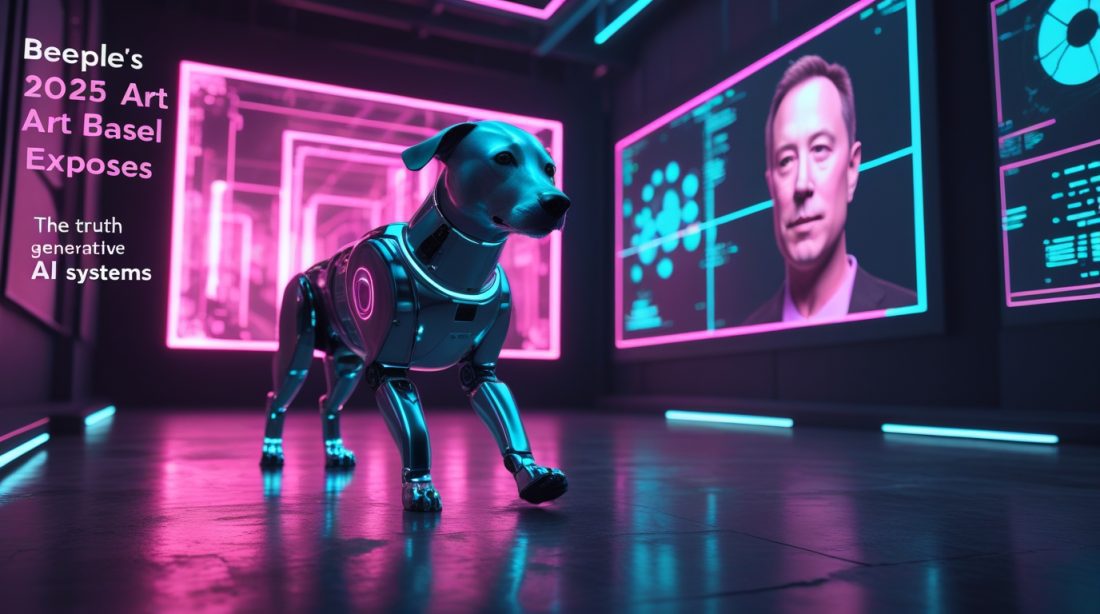
At Art Basel Miami Beach 2025, the most talked-about spectacle wasn’t a painting or sculpture in the traditional sense. It was a pack of robotic dogs, fitted with hyper-realistic heads of tech titans like Elon Musk and Jeff Bezos, aimlessly roaming a pen before occasionally “pooping” out AI-generated photographs. This provocative work by digital artist Beeple, titled Regular Animals, is far more than a viral stunt. It serves as a powerful, satirical lens through which to examine a critical industrial shift: the transition from human-centered production to one dominated by generative AI systems and the powerful entities that control them. This article analyzes how Beeple’s installation captures the anxieties and market realities of this transformation, where algorithms don’t just recommend content—they actively reshape creative markets, labor, and our very perception of reality.
Why Beeple’s Satire Perfectly Captures Modern Generative AI Systems
At first glance, Regular Animals is absurd. Custom robot quadrupeds with the silicone faces of Musk, Zuckerberg, Bezos, and artists like Andy Warhol and Pablo Picasso wander a plexiglass enclosure. Each unit is equipped with a camera, continuously capturing its surroundings. Using integrated artificial intelligence, it then “reimagines” this visual data according to a pre-programmed style—Warhol’s pop art, Picasso’s cubism, or a schematic “Elon Musk” aesthetic—before physically printing and ejecting the image.
Beeple, whose real name is Mike Winkelmann, frames this as a direct analogy for our current digital ecosystem. “We’re increasingly going to view the world through AI,” he states. “We’re also seeing the world through the lens of… tech leaders like Elon Musk and Mark Zuckerberg who shape what we see, probably more than anybody else”. In this industrial analogy, the robots are the platforms and algorithms, their heads represent the biases and commercial motives of their owners, and the “pooped” images are the curated, often sensational, content we consume daily. The installation makes the often-invisible process of algorithmic curation embarrassingly literal and physical.
A Glimpse into the Market: Why AI Art is Crowding Out Human Creators
The market reaction to Beeple’s work was immediate—all robot editions sold for $100,000 each during the VIP preview. This commercial success mirrors a broader, more disruptive trend occurring across creative industries, a trend backed by concrete data.
A pivotal 2025 study from Stanford Graduate School of Business analyzed an online image marketplace before and after it allowed AI-generated content. The findings provide a sobering forecast for human creators:
- Market Flood and Exit: Following the introduction of AI, the platform saw a 78% monthly increase in available images, almost exclusively from AI. Concurrently, there was a 23% drop in non-AI artists actively selling on the site.
- Consumer Preference Shift: Overall sales grew by 39%, but purchases of human-made images fell, indicating that AI work is becoming a direct substitute.
- Increased Competition and Quality: The remaining human artists improved the quality of their work, but the study authors conclude that “GenAI is likely to crowd out non-GenAI firms and goods”.
Table: Market Impact of Introducing AI-Generated Art
Beeple’s robots, each a $100,000 commodity producing endless automated art, are the physical embodiment of this economic model. They represent a future where the means of production are autonomous, owned by a few, and capable of overwhelming traditional supply.
The Creative Paradox: Can AI Be a Tool Without Becoming the Artist?
Beyond economics, Regular Animals taps into the profound cultural debate about the nature of creativity in the age of AI. The installation forces viewers to ask: where does the “art” reside? In the machine’ programming? In Beeple’s concept? Or is the truly creative act the viewer’s own horrified or delighted reaction?
This debate is central to the industry’s future. As Harvard experts note, AI excels at mimicry and recombination but lacks the lived experience, intentional emotion, and capacity for genuine surprise that define groundbreaking human art. A novelist points out that AI might master commercial genres but will lack “true insight and experience”. A jazz musician emphasizes that AI cannot replicate the in-the-moment interplay and emotional transmission of a live performance.
However, many artists see it as a powerful new tool. “We should be grateful to be challenged and knocked out of our habits and assumptions!” says mixed-media artist Matt Saunders. Beeple himself occupies this middle ground; he uses AI as a tool within his work to critique the very systems that power it. His robots don’t just use AI—they are a commentary on an AI-driven world, highlighting the loss of human agency and the strange, often crude, outputs of these systems.
The Industrial Outlook: What Beeple’s Dogs Tell Us About Our Automated Future
The broader industrial lesson of Regular Animals extends far beyond the art gallery. Beeple has built a functional model of an automated industrial process: perception (camera), processing (AI model), and production (printed image/NFT). Its dystopian humor lies in framing this slick pipeline in the most base, biological terms possible.
This reflects real-world tensions in sectors from manufacturing to content creation, where the integration of smart, autonomous systems promises efficiency but threatens displacement and raises ethical questions about control and bias. The installation’s subtext—that the machines will one day stop working, programmed with a finite three-year lifespan for their core function—is a poignant reminder of planned obsolescence and the fleeting nature of our current technological paradigms.
As industries race to adopt generative AI, Beeple’s work serves as a crucial cultural checkpoint. It asks us to look critically at who builds these systems, what data they are trained on, and whose interests they ultimately serve. In an era where algorithms increasingly mediate reality, understanding the “why” behind their design is not an artistic luxury—it is an industrial and societal imperative.
Frequently Asked Questions (FAQs)
What is Beeple’s Regular Animals installation?
Regular Animals is a digital art installation by Mike Winkelmann (Beeple) featured at Art Basel Miami Beach 2025. It consists of robotic dogs with hyper-realistic heads of figures like Elon Musk and Andy Warhol that wander an enclosure, take photos, and use AI to output styled images in a satirical commentary on algorithmic culture.
How does AI-generated art affect human artists?
Research indicates a dual impact. The introduction of AI art into marketplaces significantly increases total supply and sales but acts as a substitute for human-made work, leading to the crowding out of some artists. Surviving artists often see increased competition that pushes them to improve quality.
Is AI-generated content considered real art?
This is a central debate. Many experts argue that while AI can be a powerful tool for artists, it lacks the intentionality, emotional depth, and lived experience that define human artistic creation. The consensus is that AI is a new medium or collaborator, but the creative vision still fundamentally resides with the human artist.
Fast Facts
Beeple’s Regular Animals at Art Basel—featuring robot dogs with billionaire heads that poop AI-generated pictures—is a sharp satire of our algorithmic age. It visually critiques how tech moguls and the underlying generative AI systems shape our perception. Behind the spectacle, it mirrors a real industrial shift where such systems flood creative markets, crowding out human artists, as shown by studies on AI’s market impact. The work sparks the essential debate on whether AI is a tool or a replacement for human creativity.
To stay ahead of the trends shaping the future of industry and technology, subscribe to our newsletter for in-depth analysis delivered to your inbox.
Further Reading & Related Insights
- AI Agent Automating Desktop Tasks → Explores how agentic AI moves from chat to direct computer control, complementing Beeple’s critique of systems that act autonomously.
- Industrial Robot Rental Costs Slashed → Shows how industrial automation is becoming more accessible, echoing Beeple’s theme of machines reshaping labor and markets.
- Managing Orphaned AI Models: Industrial Risk → Discusses governance and risk in AI adoption, aligning with Beeple’s commentary on control and bias in generative systems.
- AI and Robotics Replacing Jobs → Examines workforce displacement, directly tied to Beeple’s satire of human creators being crowded out by AI art.
- AI Bubble Narrative: Industrial AI ROI → Analyzes hype versus reality in AI investment, reinforcing the article’s industrial outlook on generative AI flooding markets.