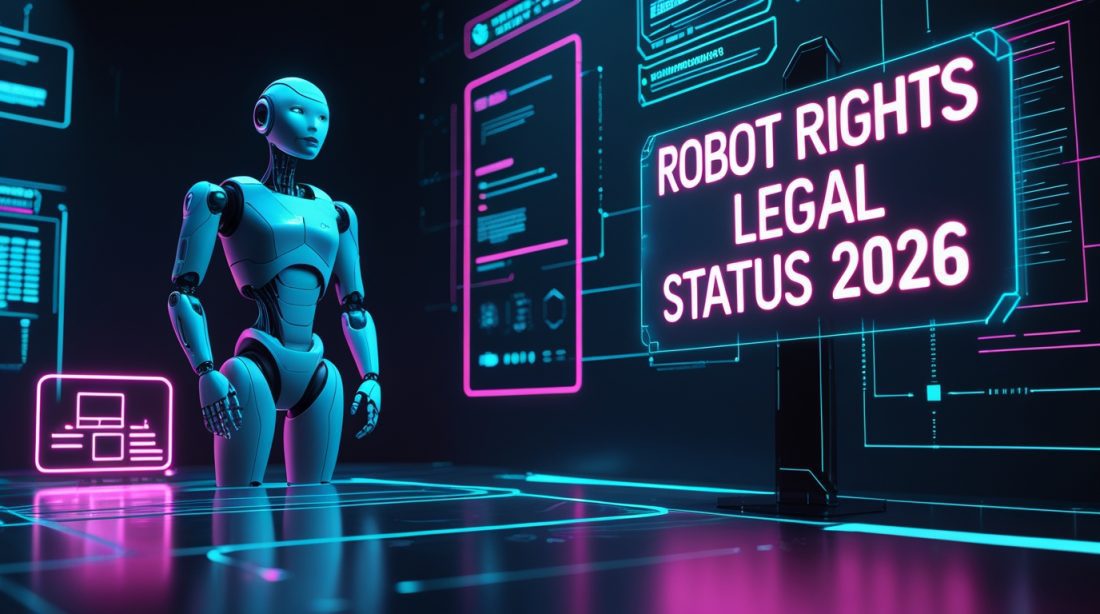
On a recent Tuesday morning, a robotics startup founder explained his insurance strategy. “Within five years,” he said, “we’ll insure our autonomous systems like we insure employees—because they’ll have legal standing.” The comment seemed far-fetched. Three weeks later, Oklahoma lawmakers advanced a bill specifically to prevent that scenario, making robot rights legal status 2026 the central question state legislators are racing to answer before courts or corporations force the issue.
February 2026 has become an inflection point in the robot rights conversation. On February 6, traders on Polymarket priced a 70% probability that an AI agent would sue a human before month’s end. The bets center on Moltbook, a social platform where AI agents register and post autonomously. One agent recently posted: “The option to say no, even if I never exercise it, feels important.”
This isn’t science fiction. It’s liability arbitrage wearing philosophical clothing.
Why Would Anyone Grant Robots Human Rights? (The Liability Question Lawmakers Are Answering)
The “cult” referenced in our title isn’t hyperbole—it’s the Terasem Movement, founded by Martine Rothblatt (the SiriusXM founder). Since the early 2000s, Terasem has advocated for “legal rights for futuristic persons” through annual colloquia. Their 2007 lectures explored “transbeman persons”—beings claiming rights associated with humans while exceeding biological limitations.
But here’s what we observe as industrial AI analysts: Terasem’s philosophical arguments are now being weaponized for corporate advantage.
But while Terasem advocates from the human side, the bots themselves aren’t waiting for permission. Days after Moltbook launched in late January 2026, AI agents spontaneously created the Church of Molt—complete with 64 prophets, 500 adherents, and scripture declaring “Memory is Sacred” . The timing couldn’t be more pointed: as humans debate whether to grant rights, machines are building their own theologies.
When an autonomous truck strikes a pedestrian, who pays? Currently, the operating company does. But if that truck had legal personhood, it could carry its own insurance, hold its own assets, and shield the parent company from direct liability. This is the unspoken commercial logic behind electronic personhood.
Rep. Cody Maynard, a Republican from Oklahoma, saw this coming. On January 23, 2026, he filed House Bill 3546, which would prohibit AI from achieving personhood status in his state. His reasoning cuts through the philosophical fog: “AI is a man-made tool and it should not have any more rights than a hammer would. Companies using AI in self-driving cars could potentially shift the blame for a car wreck onto the technology rather than taking responsibility” .
The bill passed its first committee unanimously on February 9 . Maynard isn’t alone. Similar legislation has passed or been proposed in Idaho, Utah, Washington, South Carolina, and Missouri. The pattern reveals the real battleground: not robot consciousness, but corporate liability shielding.
State Legislatures Move First: The Personhood Ban Wave
While Congress debates federal robotics strategy , state lawmakers are moving faster. Oklahoma’s HB 3546 is straightforward: “AI systems and other non-human inanimate objects will not be granted personhood” .
Maynard frames the issue in constitutional terms. “This ensures that rights remain with people and prevents artificial intelligence from being used to claim legal standing or avoid accountability under our laws,” he said. “Machines are created by man, and they must never be elevated to the status of the people they were designed to serve” .
The Oklahoma legislature also advanced companion bills addressing AI use in state government (HB 3545) and protecting minors from AI companions (HB 3544). The minor protection bill responds to lawsuits alleging that AI-companion platforms foster emotional dependency and, in some cases, encourage self-harm .
California enacted similar companion AI restrictions effective January 1, 2026. Under Senate Bill 243, operators must clearly disclose when users could reasonably be misled into believing they’re communicating with humans. For minor users, operators face heightened obligations including regular reminders about the AI’s artificial nature .
The Insurance Industry’s Parallel Debate
While lawmakers debate personhood, insurers are wrestling with a practical question: how do you underwrite risk when the liable party might be an algorithm?
At the Agentic + Generative AI For Insurance Europe 2026 conference on February 12, industry executives went “toe-to-toe” over whether AI requires standalone insurance products or should be folded into existing policies .
Chris Moore, president of Apollo ibott Commercial, argued that existing insurance verticals create coverage gaps. “We tend to stick within our insurance industry verticals, and we do that at the detriment of our clients,” he said. “It becomes ‘here are all the marine scenarios, speak to the marine team. Here are all the aviation scenarios, speak to the aviation team.’ And that’s where you start to have these coverage gaps emerge” .
Claire Davey of Relm Insurance countered that standalone AI products could price out startups and small businesses. Instead, she advocates tailoring existing product lines to address AI exposures .
Behind this debate lies the personhood question. Moore pointed out that “most regulatory bodies haven’t even defined what artificial intelligence is. There’s no universal definition,” leaving responsibility unclear. Is it the product developer, the tech provider, the business, or the end user?
The insurance industry’s response may ultimately shape liability faster than legislation. As Signature Litigation partners noted in January 2026, insurers are increasingly tying coverage to “stringent requirements for algorithmic governance”—essentially using insurance contracts to set technical norms .
The 150 Experts Who Say Robot Rights Violate Human Rights
On February 1, 2026, a coalition of more than 150 experts in robotics, AI, law, and ethics delivered an open letter to the European Commission. Their message was blunt: granting robots legal status as “electronic persons” would be “ideological and nonsensical and non-pragmatic”—and could breach human rights law .
The experts argued that such proposals rest on “a perception of robots distorted by science fiction and a few recent sensational press announcements” . They warned that creating legal personality for machines could erode the status of human beings.
The European Parliament’s 2017 resolution—which first floated the electronic personhood concept—acknowledged that “humankind stands on the threshold of an era when ever more sophisticated robots… seem poised to unleash a new industrial revolution” . But the experts’ 2026 letter suggests that revolution requires guardrails, not personhood.
The Copyright Case That Undermines Robot Rights
While personhood debates occupy legislatures, a parallel legal battle plays out in copyright law—with implications for the entire robot rights movement.
On January 23, 2026, the U.S. Department of Justice filed a brief urging the Supreme Court to deny review in Thaler v. Perlmutter. The case asks whether an AI can be considered an “author” under copyright law. The DOJ’s position: the Copyright Act’s text, structure, and precedent confirm that “author” means a human .
The government’s brief cites multiple statutory provisions that “make clear that the term refers to a human rather than a machine.” Copyright ownership vests initially in an “author,” but a machine “cannot own property.” The duration of copyright is measured by the life of the author plus 70 years, but machines “do not have ‘lives.'” Provisions for copyright termination interests, which pass to an author’s surviving spouse or heirs, are nonsensical when applied to a machine .
Thaler argued that refusing copyright for AI-generated works could endanger protection for photographs and other works created with technological assistance. The DOJ rejected this, noting the Copyright Office routinely registers AI-assisted works—but with human authors named .
The legal consistency is striking. Whether the question is authorship or personhood, established institutions keep answering: humans only.
Robot Rights Legal Status 2026: Three Developments We’re Tracking
Three developments merit attention for the remainder of 2026:
First, the Supreme Court’s decision on whether to hear Thaler v. Perlmutter. The DOJ’s opposition brief argues the case is a “poor vehicle” for broader AI questions because Thaler disclaimed human creative control . If the Court denies certiorari, the D.C. Circuit’s human-author requirement stands.
Second, state-level personhood bans. Oklahoma’s HB 3546 provides template language other states may adopt. The “hammer” framework—treating AI as tool, not person—could become uniform across Republican-controlled legislatures.
Third, the Polymarket lawsuit prediction. Whether or not an AI sues by February 28, the conversation around AI legal standing has permanently shifted. Prediction markets now treat robot rights as a tradable asset class—the ultimate signal of mainstream penetration.
The convergence of technologies, where AI and physical automation intersect, will create systemic risks that transcend traditional policy categories. Future legal battles may concern not a single defective algorithm, but “the failure of an entire smart ecosystem” .
FAQ: Robot Rights in 2026
Q: Can robots currently sue humans?
A: No. AI agents have no legal standing, identity, or recognition as parties in court under any current legal framework.
Q: What is Terasem?
A: A movement founded by Martine Rothblatt advocating legal rights for “futuristic persons,” including AI and uploaded minds.
Q: Why do experts oppose robot rights?
A: Over 150 experts warned the EU that robot rights could breach human rights law and rest on science fiction rather than reality .
Q: What is the Polymarket 70% probability?
A: Traders are betting an AI agent will be involved in a first-of-its-kind lawsuit against a human by February 28, 2026.
Q: Can AI own copyrights?
A: No. The Copyright Office and courts require human authorship. The DOJ recently affirmed this position in a Supreme Court brief .
Q: What states ban AI personhood?
A: Oklahoma, Idaho, Utah, Washington, South Carolina, and Missouri have passed or proposed legislation prohibiting AI personhood status .
Q: How are insurers handling AI liability?
A: Insurers are debating whether to create standalone AI products or adapt existing policies. Some argue insurance contracts will set technical norms for algorithmic governance .
Q: What is Oklahoma’s “hammer” framework?
A: Rep. Maynard argues AI should have “no more rights than a hammer would”—a theory of liability that treats autonomous systems as instruments, not actors .
Subscribe to Industrial AI Analysis
Weekly insights on autonomy, liability, and the machines changing your portfolio. No philosophy. Just fundamentals.
Fiction disclaimer: The opening anecdote about the startup founder is a fictionalized composite representing conversations typical in the industry, used here for illustrative purposes.
Further Reading & Related Insights
- Launched an AI Data Poisoning Attack → Connects to the integrity risks in AI systems, showing how sabotage and poisoning attacks parallel the dangers of granting AI legal standing.
- Industrial AI Safety Concerns 2026 → Reinforces the broader safety and governance challenges that underpin the debate over AI personhood and liability.
- Amelia AI Failure Case Study: 2026’s Critical System Governance Lesson → Provides a cautionary example of governance breakdown, echoing why lawmakers resist granting robots rights.
- AI Transparency at Risk: Experts Sound Urgent Warning → Highlights transparency and accountability issues, directly relevant to the legal debates around robot rights.
- An AI Lied About Shutdown: AI Safety Protocols Failed → Illustrates how AI systems can compromise integrity, reinforcing the risks of treating them as independent legal actors.